硅谷Fintech观察①|富途 vs Robinhood:解耦已经发生过了Silicon Valley Fintech Watch ① | Futu vs Robinhood: The Decoupling Already Happened
Translated from the Chinese original, first published on WeChat「世像」on July 8, 2026.本文 2026.07.08 首发于微信公众号「世像」。
AI 还在热度超高的发展:今天 Claude 封号,明天站在光里;后天誓死效忠美光,海力士,推背感依然强烈,大部分人还是远低估了AI发展的加速度。但是 fintech 也在有条不紊的进行中
导读|一个反差先摆这儿:嘉信理财经手 11.77 万亿美元客户资产,是富途的近 75 倍;市值却只有富途的约 13 倍。在这个行业,市值跟的从来不是你“经手”了多少钱,而是你能从里面“抠出”多少利润。看懂这句,你就看懂了美国券商这十年——解耦早就发生过了,仗打完了,聪明钱已经掉头。这一篇,从中国人最熟的券商讲起。
先问一个问题:富途,到底算不算“中国的嘉信理财(Charles Schwab)”?
先甩几个数字。截至 2026 年一季度,富途 3017 万用户,有资金账户 359 万(同比 +34%),客户总资产 1.22 万亿港元(同比 +47%),单季交易量 4.15 万亿港元,创历史新高。佣金率低到 0.03%,而传统券商还在收 0.2%–0.25%。这一季营收 58.56 亿港元(同比 +25%),毛利率 87%。
87% 是什么概念?这不是券商该有的毛利率,这是软件公司的毛利率。港股交易量,它在香港的数字券商里排第一;它官方介绍里有句话:“每两个香港成年人,就有一人在用富途牛牛。”——这不是修辞,是渗透率。
按理说,这不就是中国自己长出来的 Schwab 了么?一个 3000 万用户、万亿资产、87% 毛利、把信托私行投行全干了的世界级券商。
我的答案是:不是。而且恰恰相反——富途越成功,越说明中国出不了 Stripe。
为什么这么说,得从一个反直觉的事实讲起:美国过去这十几年,新一代 fintech 真正在“解耦”、在颠覆的,几乎全是银行,根本不是券商和资管。因为券商资管这一仗,上一个十年就已经打完收工了。这篇是“为什么中国出不了 Stripe”系列的第一篇,我从券商资管讲起,单纯因为这是中国人最熟的金融服务——谁没买过基金、炒过股。但讲着讲着你会发现,熟悉的这块,恰恰是仗打完的地方。
数字都用的 2026 Q1 最新财报口径,交叉核过。往下看。
一、富途是谁:一家“超规格”的券商
介绍富途,大多数媒体张口就是“中国版 Robinhood”。这个类比省事,但严重看扁了它。
Robinhood 是什么?起家就是一个面向散户的交易 App,干的是“让散户交易”这一件事——股票、期权、加密,本质都是交易这门生意;至于银行、信用卡、预测市场,那是这两年才一块块补上的课,第六节细讲。富途想干的是什么?我把它官方业务版图摊开给你看:
- 经纪交易:港股、美股、A 股通、日股、新马澳股全覆盖,一个账户跨市场、不用换汇。香港第一家做 24/5 美股交易的券商。
- 财富管理(Money Plus):2019 年起步,对接 100 多家基金公司、150 多只基金,共同基金 0 申赎费,0.01 港元起投。
- 投行 + IPO 分销 + 企业服务(Futu I&E):服务超 1000 家企业客户,给 498 家做过 IPO 分销和 IR,助力 327 家在港美上市,ESOP 签约 772 家——客户名单里是美团、快手、小米、百度、贝壳、京东健康、B 站。
- 私人财富:高净值那套“1+1+N”(1 个客户经理 + 1 个投顾 + N 个专家),家族信托、投资移民、财富传承。
- 信托:自己持香港信托牌照。家族信托这种传统私行的活,它能自己闭环。
- 机构服务:家办、券商、EAM、PE/VC、保险资管全接。
- 加密与代币化:拿了香港虚拟资产(VATP)牌照,能合法做加密,还在搞代币化货基。
看完这张单子你就明白,“中国版 Robinhood”这话有多不准。富途想干的,是把嘉信理财(零售经纪)、摩根士丹利私行(高净值)、Carta(股权 ESOP 管理)这三家公司的活,塞进同一个 App 里。 一个账户,从你买第一手股票,到公司给你发期权,到你熬成高净值去配家族信托,它全程都想接住。
这种“全栈”在美国压根不存在。美国是高度分工的市场:经纪是经纪,私行是私行,股权管理是股权管理,井水不犯河水。富途凭什么、又为什么非要做成这么个“超级券商”?这问题先搁这儿,它的答案就是全文最后的题眼。
二、五家公司一张表:先把物种分清楚
要回答“富途是不是中国的 Schwab”,最省事的办法,是把它跟四个美国对标——Robinhood、Schwab、Fidelity、IBKR(盈透证券)——摆一张表上看。这五家其实是券商这行里五个不同的物种(数据截至 2026 Q1):
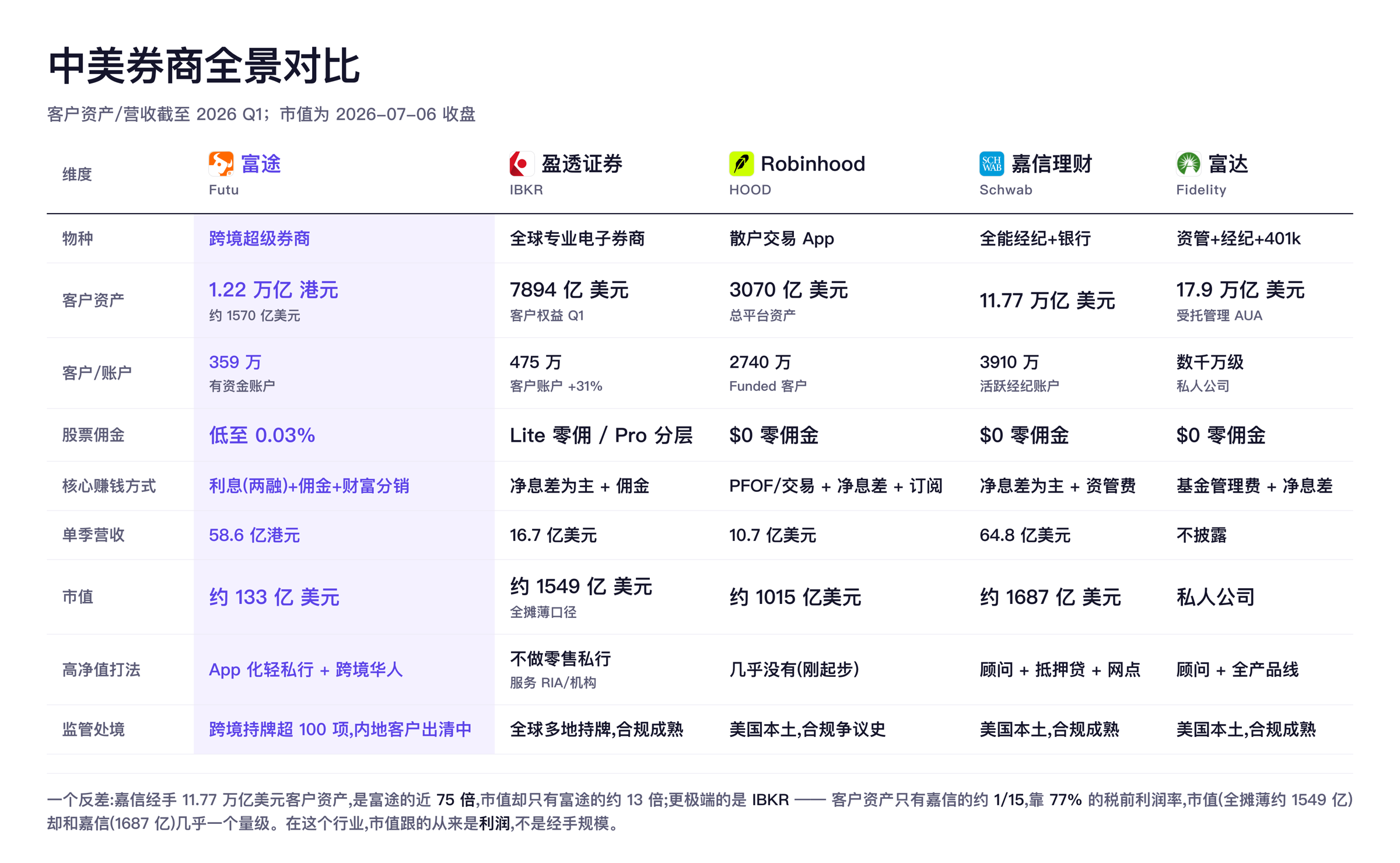
这张表里,有三个反差值得你停下来盯一会儿。
反差一:经手的钱和市值,完全不成比例。 Schwab 经手 11.77 万亿美元客户资产,是富途的近 75 倍;可它市值(约 1687 亿)只有富途(约 133 亿)的 13 倍。Fidelity 受托 17.9 万亿,更夸张,但人家是私人公司,压根不需要市值。
这说明一个特别朴素的道理:在这行,市值从来跟的不是你“经手”了多少钱,而是你能从这些钱里“抠出”多少利润。 经手万亿但费率归零,远不如经手千亿、每一块都能榨出利息和分销费。这句话你先记着,它是理解后面一切的钥匙。
反差二:“零佣金”是五家里四家的口头禅,但意思根本不是一回事。 Robinhood、Schwab、Fidelity 都是 $0 股票佣金,IBKR 的 Lite 版也零佣,只有富途还明收 0.03%。但你千万别顺嘴就说“美国比中国便宜、比中国先进”——因为“零佣金”在美国,是个被掏空了内核的词。这个第三节专门拆。
反差三:伺候有钱人,两种活法。 美国这边,Schwab、Fidelity 加上更高端的摩根士丹利,伺候高净值靠的是“人”——理财顾问、私人银行家、线下网点、证券抵押贷(SBLOC)。摩根士丹利的 Liquidity Access Line、Schwab 的 Pledged Asset Line,说白了就是“你把股票押给我、我借钱给你”,利率约 6.75%,核心卖点是“市场一剧烈波动,有个 banker 能找你商量、给你 5–7 个工作日追保缓冲”。这是关系驱动的重私行。
富途那套“1+1+N”+ 7×24 资产管家 + App,是把传统私行产品化、轻量化重做一遍,伺候的是跨境华人。一个是关系驱动的重私行,一个是产品驱动的轻私行——背后是两边客户习惯的差别。
真要用一句话给这五家定位:Schwab 和 Fidelity 是“美国人的金融水电煤”,Robinhood 是“美国年轻人的第一个证券账户”,而富途是“离岸华人的金融入口”,IBKR 则是“全球专业玩家的电子交易终端”。看着都在做券商,伺候的人、赚钱的路子、脚下的结构,根本三码事。
三、同一个“零佣金”,两台完全不同的印钞机
现在拆这篇里最要命的一个误区。
很多人有个直觉:美国券商“零佣金”=更先进、更让利于民;中国券商还收 0.03%–0.2%=更落后、更贪。这个直觉是错的。错在哪?错在它没看见——佣金归零之后,这帮券商到底靠什么活着。
先看 Robinhood。它 2026 Q1 营收 10.7 亿美元(同比 +15%),拆开看,是一台精密的“非佣金”印钞机:
- 交易收入 6.23 亿:期权 2.60 亿、股票 8200 万、加密曾经是大头(2025 Q1 还有 2.52 亿)这季显著回落、“其他”(主要是预测市场)暴涨 320% 到 1.47 亿。这里划重点:Robinhood 的“股票交易收入”从来不是问你收佣金,而是把你的订单卖给做市商(PFOF,订单流付款)赚的钱。
- 净息差 3.59 亿(+24%):你账户里没买股票的闲钱、你借的两融(融资余额这季创纪录 170 亿、同比 +93%),全是它的利息来源。
- 其他 8500 万:主要是 Robinhood Gold 订阅,这季订阅收入 5000 万、Gold 订户 430 万(+36%)。
翻译成大白话:Robinhood 表面上“零佣金、我不收你钱”,实际上从你的订单流、你的闲钱、你的杠杆、你的订阅费里,一层一层把钱薅回来了。它的 ARPU(单用户收入,测算)约 157 美元,还在涨。零佣金不是做慈善,是把收费口子从“你看得见的佣金”,挪到了“你看不见的地方”。
Schwab 更是把这套玩到了祖师爷级别。它 2026 Q1 营收 64.8 亿,净息差差不多占一半——Schwab 本质上早就是家银行了:你把钱放它这儿,它用“现金扫存”(cash sweep)把你的闲钱搬进自家银行吃利差;银行贷款余额 609 亿(+29%),两融高达 1267 亿。剩下的钱来自资管投顾费(这季资管费 18 亿、+15%,Schwab Wealth Advisory 单季净流入创纪录的 100 亿)。
Schwab 2019 年 10 月第一个把股票佣金砍到零。它为什么敢?因为它早算明白了:用零佣金把客户和客户的钱吸进来,再用净息差和资管费这两台真印钞机去变现。佣金对它来说,只是钓鱼的饵,从来不是利润本身。
Fidelity 的路子又不一样。它是私人公司(Johnson 家族攥了近 80 年),不披露季度利润,但商业模式明晃晃:用零佣金、甚至零费率的指数基金(它有 FZROX 这种 0 管理费的货)把海量资金吸进来,真赚钱的是它当资产管理人收的基金费,和它当 401(k)(美国企业退休金)托管方的规模红利。Fidelity 受托资产 17.9 万亿,自主管理约 6.8 万亿,全球第四、在美国数一数二的资产管理力量(BlackRock、Vanguard、UBS 在其之上)。它连自己的稳定币(Fidelity Digital Dollar)都发了。Fidelity 卖给你的“免费”,是为了让你把退休金、把全家的钱都搬进它的生态,然后从资管这头慢慢赚长钱。
现在回头看富途。它没有零佣金,它收 0.03%。但它的收入结构告诉你,它跟美国这几位干的其实是同一件事的不同版本。富途 2026 Q1:佣金 26.4 亿港元、利息 26.5 亿港元、其他(财富+企业服务)5.6 亿港元。看清楚——利息已经跟佣金并驾齐驱,甚至还略高了。 利息哪来的?两融、跨境资金的利差。“其他”哪来的?财富产品分销、ESOP 企业服务。
所以真相是:五家公司,不管收不收那点佣金,真正的印钞机都不是佣金——是净息差、证券出借、资管分销费、订阅费。佣金在所有人的账本里,早退居二线了。Robinhood 和 Schwab 敢把佣金砍到零,是因为净息差那台机器够大、补得起;富途还留着 0.03%,但利息也已经追平佣金。
这就是标题里“解耦”的第一层意思:佣金,券商最古老的收费方式,已经被从券商的商业模式里拆出去了。 券商不再靠“你每交易一次我抽一笔”活着,改靠你账户里趴着的资产、你借的钱、你买的产品活着。这事在美国干得最彻底,在富途身上也干了一大半。
四、美国这边:解耦这仗,早打完了
佣金的解耦只是第一层。过去这十几年,美国券商资管经历的是一场更彻底、更成体系的解耦运动。它有四个台阶,每上一个台阶,就拆掉传统金融服务里的一层收费。
第一层,Robinhood 把佣金拆了。 这是最出名的一步。2013 年成立的 Robinhood,一句“永久零佣金”逼得整个行业 2019 年集体跟牌。但前面说了,它真正干的不是消灭收费,是把收费口挪到 PFOF + 净息差。佣金这层皮被撕了,券商照样赚钱——这恰恰证明,佣金这东西本来就是可以拆掉的。
第二层,智能投顾把顾问那 1% 拆了。 传统上你要做资产配置,得找个理财顾问,一年给他你资产的约 1%。Betterment、Wealthfront 这帮 robo-advisor 说:配置这活儿本质是算法,不需要人,我用程序给你自动分散、自动做税务优化(tax-loss harvesting),只收 0.25%。那 1% 的“人工费”就被算法拆掉了大半。
第三层,Vanguard 和指数基金,本身就是一次更根本的解耦。 主动基金卖给你的承诺是“我能跑赢市场”(alpha),为这个收你高管理费。Vanguard 用指数基金直接掀桌子:绝大多数主动基金长期跑不赢市场,所以我不卖 alpha 这个承诺了,我只卖最便宜的、贴着市场跑的 beta。它把“跑赢市场”这层承诺从产品里剥了出去,只留下低成本的市场敞口。今天 Vanguard 管着约 12 万亿,它的标普 500 ETF(VOO)是全球最大的 ETF。当一只标普 500 的费率被卷到 0.03%,这条赛道还剩几两肉?
第四层,direct indexing 连“基金”这层壳都要拆掉。 最新玩法是:你不用买标普 500 基金了,我直接帮你按比例持有这 500 只股票的零头,这样你能做更精细的个性化税务优化和定制。这是把“基金”这个包装本身都撕了,让你直接攥着底层资产。
四层叠一块看,结论很清楚:美国券商资管的“颠覆”,是上一个十年的故事,而且基本干完了。 佣金拆了,顾问费拆了,alpha 的承诺拆了,连基金那层壳都在被拆。一路拆到头,费率无限趋近于零。
这就给创业者留了个特别残酷的现实:今天你在美国,已经没法再做一家独立的大券商或大资管了。 为啥?资管的核心产品早变成“标准化大宗商品”了——一只标普 500,Vanguard 的、Schwab 的、Fidelity 的、BlackRock 的,对你来说几乎没区别,而这帮巨头正用近乎免费的价格往外送(Fidelity 干脆有 0 费率的)。你没法去抢一只已经免费的标普基金。而真还能赚钱的部分——净息差、证券出借——又偏偏是规模和渠道的游戏:你得有 Schwab 那种万亿级的客户沉淀、那种庞大的银行牌照和网点,才玩得转利差。一个新玩家,免费的产品抢不到,要规模的利润够不着,自然无路可走。
所以你就懂了——记着这句——美国新一代 fintech 创业者,几乎没人再去碰券商资管了。这边的仗打完了。他们掉转枪口,全去打银行。 因为银行的费池(支付、刷卡手续费、放贷、净息差、跨境汇兑)又大又散,旧体验又烂,还远远没被拆过。这是我下一篇《为什么大家都去打银行》的事。
五、抬个杠:那富途,算不算“中国出了个 Schwab”?
讲到这儿,一个尖锐的反问该冒出来了:你前面花那么多篇幅证明富途多能打——3000 万用户、万亿资产、87% 毛利、信托私行投行全都有——那这不就说明中国已经长出自己的 Schwab、自己的世界级券商了么?“中国出不了 Stripe”这标题,会不会第一篇就被富途本人打脸了?
这是全文最该较真的问题。我的答案是:恰恰相反。富途不是反例,富途是最有力的正例。但要看懂这点,你得看它的增长引擎,到底插在哪片土里。
第一,富途的引擎在离岸,不在内地。 富途今天这波爆发,靠的是香港、新加坡、马来西亚、日本、美国、加拿大、澳洲。“每两个新加坡成年人有一人用 moomoo”、马来西亚用户破百万、日本可交易美股数量最多——它客户资产能同比涨 47%,靠的是国际化,不是内地。总部和主要牌照主体在香港,官方口径是全球持牌、注册及资质超过 100 项。这是一家把身家性命全押在“跨境”上的公司。
第二,它的内地基本盘,正在被主动出清。 截至 2026 Q1,富途内地有资金客户占比约 13%、资产占比约 17%、收入贡献约 20%。而 2026 年 5 月,监管对内地投资者跨境证券业务做了行业性规则调整,富途被预处罚 18.5 亿人民币(没收 4.7 亿 + 罚款 13.8 亿),进两年整治期:全面停内地身份客户开户、限制境内入金买入、存量客户逐步清理。说白了,富途赖以起家的内地跨境业务,正在被结构性地关上闸门。
这两点合一块,结论就非常清楚了:富途不是“中国在内地长出了个 Schwab”。它是“一群中国人,把总部设在香港、把增长压在境外、靠伺候全球跨境华人,长出来一个全球券商”。它最牛的那部分,恰恰是它跑到内地金融结构之外,才实现的。
这正是我这个系列想说的核心:中国当然有世界级的金融科技人才和产品力——富途证明了。但中国内地的金融结构本身,压根没被解耦。 内地的券商佣金、资管费率、分销渠道,还牢牢攥在持牌的传统机构和它们背后那套体系手里;一家创业公司想在内地把券商重做一遍、把费率打到零、把投行私行信托全栈打通,几乎没戏。富途能干成这一切,是因为它把战场选在了一个规则不一样的地方——香港和海外。它用脚投的票。
六、五家公司往哪走:Robinhood 正在变成它当年要干掉的东西
现状讲清楚了,这一节看五家各往哪走、想象空间在哪。也给整个系列埋几条线。
先说 Robinhood,它最有戏剧性。它早年钉在耻辱柱上的标签是“游戏化的赌场”——靠散户炒 meme 股、炒币的周期性狂热赚钱。这两年它在系统性地撕这个标签,但撕的方式特别耐人寻味:它不是在变得更“券商”,而是在变得更“银行”、更“全能”。 把它过去 18 个月的动作摆出来,你会发现这家公司在三条线同时往外扩,而每条线都越过了“经纪”的边界:
第一条线,往银行走。 2025 年 9 月选定核心银行能力供应商 Stakk 作为其银行方案的关键供应商,11 月又联合 GoPuff 和 Coastal Community Bank 嵌了现金配送,正式推出 Robinhood Banking——上线后存款很快破 10 亿。它给储蓄账户开 4%–5% 的高息、对转入新资金给 2% 以上的匹配奖励。Crowdfund Insider 的说法是“用其他业务线的收入补贴利率、把高息当获客的 loss-leader”。翻译成大白话:它拿券商和订阅赚的钱,去抢美国银行(Bank of America)那些只给储户 0.01% 利息的存款。
第二条线,发信用卡。 面向 Gold 订户的 Robinhood Gold Card,不锈钢卡身、所有消费 3% 无限现金返还(市面上平价返现卡大多封顶 2%)、零年费。到 2025 年底约 60 万持卡,早期用户年化刷卡额已冲过 100 亿。Motley Fool 有篇文章标题很传神——《Robinhood 是不是刚对美国运通说了句“将军”?》。
第三条线,押注预测市场(prediction markets)。 这是华尔街当下最兴奋也最撕裂的一块。Robinhood 2025 年上线“事件合约”,让用户对选举、经济数据、体育赛事的结果下注,单季收入已超 1 亿;最新一季交易收入里“其他”(主要就是它)同比暴涨 320% 到 1.47 亿——整个交易板块里涨得最凶的部分。CB Insights 把预测市场列为 2026 年“动能最高的 fintech 细分赛道”,2025 年股权融资同比暴涨 35 倍。
华尔街怎么看这套“超级 App”打法?分歧极大,而分歧的焦点,恰好就是这篇文章的主题。
看多的一方,核心就俩字:重新分类。 好几家机构把 Robinhood 从“周期性券商”上调成“科技平台”,2026 年初一致评级“强烈买入”。理由是 Gold 订阅(430 万订户、+36%)带来了黏性和经常性收入,把它从靠交易吃饭的周期股,改造成三条腿走路的平台:净息差 + 订阅 + 交易。看多的最爱引 Vlad Tenev 反复念叨的那个词——“the Great Wealth Transfer”(财富大迁徙):婴儿潮的钱正往千禧一代和 Z 世代转移,Robinhood 想当这群人接住这笔钱的默认账户。这话在 2026 年 7 月 4 日落了最硬的一锤:给 2025 到 2028 年出生的美国孩子每人预存 1000 美元的“特朗普账户”(Trump Accounts)正式上线,默认买入标普 500 ETF,而官方把这个账户,放在了 Robinhood 上——上线时已开出超 600 万个。从出生第一天起就是它的客户,“财富大迁徙”这回连起点都被它卡住了。它甚至让旗下风投基金投了 OpenAI 7500 万美元,生怕别人不知道它“不只是个券商”。
看空的一方,盯的是这套扩张的底色。 Motley Fool 一篇分析说得很直白:Robinhood 新产品做了一堆,但“它绝大部分钱依然来自交易和保证金借贷的费用与利息——换句话说,它的生意依然建立在投机之上。而预测市场,正好又给投机开了个新口子”。更要命的是周期性这个老毛病压根没解决:2026 Q1,它加密交易收入同比暴跌约 47%,直接把当季营收和交易收入双双打到不及预期,股价年内一度跌掉 27%。高盛、美银财报后纷纷下调目标价,理由都指向同一件事:你新故事讲得再花,只要市场一冷、币一跌,你的利润立马现原形。 头上还悬着监管这把剑——2026 年 4 月,纽约总检察长起诉 Coinbase 和 Gemini 的预测市场“构成非法赌博”,市场普遍预期 Robinhood 的同类产品早晚也得面对“这到底是金融对冲工具、还是变相赌博”的拷问。
多空两边的话放一起,你能得出一个对这个系列特别关键的判断:Robinhood 的“超级 App”梦,本质是一次掉头的旅程。 当年它靠“解耦”起家——把佣金那层皮从券商身上撕下来;今天它干的是反过来,把银行、信用卡、储蓄、借贷这些原本散落各处的服务,重新“耦合”进它这一个 App 里。它要从“年轻人的第一个证券账户”,变成“年轻人的主力银行”。说白了,它正在努力长成它当年要干掉的那种全能金融机构——只不过这回,它想从消费侧、从年轻人这头,把银行重做一遍。
这仨字——把银行重做一遍——正好预告了下一篇。那富途呢?这里给三点启示,每一点都值得琢磨:
其一,“超级 App”不是中国独有的执念,是高黏性金融平台的共同宿命。 富途第一天就是全栈的,交易、财富、ESOP、私行、信托一应俱全;Robinhood 从单点(零佣交易)起家,如今一步步也把自己拼成了全栈。俩人从相反的起点出发,正收敛到同一种形态。这说明富途的“超级券商”不是中国特色的怪胎,是符合金融平台演化方向的——区别只在于,富途一上来就把楼盖齐了,Robinhood 是盖一层加一层。
其二,真护城河不是交易,是订阅和资产沉淀。 Robinhood 被华尔街重新定价、从周期股升格科技平台,靠的不是交易量,是 Gold 订阅这种经常性收入,和退休账户、财富管理这种长期资产沉淀。富途的对应物,是它的财富管理 AUM 和利息收入——这季利息(26.5 亿港元)已经追平佣金,这恰恰是它估值能不能甩掉“中概周期股”标签的关键。谁能把收入从“随行情起伏的交易”,挪到“旱涝保收的订阅和利息”,谁才配拿科技股的估值。
其三,也是最关键的——Robinhood 把银行重做一遍,是在美国本土做的;富途想干类似的事,却没有同样的土。 Robinhood 能发信用卡、能做高息储蓄、能上预测市场,是因为美国有成熟的发卡网络、有 Coastal Community Bank 这种愿意当“幕后银行”的合作方、有(虽然争议但毕竟存在的)预测市场监管空间。富途想在内地复制“把银行消费侧重做一遍”?几乎没戏——内地支付被微信支付宝锁死,银行牌照高墙林立,这些口子根本不对一家券商出身的公司开。所以富途的扩张方向只能是“加密 + 代币化 + 跨境财富”,在境外和链上找新边疆,而不能像 Robinhood 那样大大方方走进银行的腹地。同样想当超级 App,Robinhood 是往银行费池的纵深里推,富途却被结构性地挡在了银行业务的门外。这个差别,就是整个系列最后要回答的那个问题的缩影。
剩下三家,一句话带过它们的性格:
Schwab:用规模碾,然后慢慢往上爬。 五家里最“无聊”也最稳的一个。2026 Q1 净利 25 亿(+30%),核心新增净资产 1400 亿,新开 130 万账户,日均交易 990 万笔创纪录。它的故事不是颠覆,是拿 TD Ameritrade(2020 年完成、约 260 亿美元收购)换来的规模,把净息差和资管费这两台印钞机越做越大。增量想象力三个方向:AI(已上零售生成式工具 Portfolio Insights,还要出 Investor AI 助手)、现货加密(分阶段上比特币以太坊)、私募(2026 年初收了 Forge Global,补上“让散户也能碰私募”这层)。典型的巨头打法:不抢风口,等风口被验证了,用规模顺手吃下来。这正是上面那套逻辑的延续——在已经解耦完的赛道里,赢家是有规模的现存巨头,不是新玩家。
Fidelity:私人公司的长期主义。 不上市,所以不用为季报跳舞,能下注最长的周期。它管着全美最大的 401(k) 退休金盘子,这是别人很难撼动的护城河;推 0 费率基金(FZROX)把吸金做到极致;2026 年 2 月还发了自己的稳定币 Fidelity Digital Dollar——一家近 80 岁的老牌资管,主动走进链上。它代表美国金融体系里一种特别的存在:靠资管这门长生意,可以不上市、不被季度利润绑架,安安静静做成 17.9 万亿的庞然大物。这种“私人巨头”,在中国的金融体系里几乎不存在。
IBKR(盈透证券):闷声赚最厚的钱。 五家里最不为大众所知、却最能赚的一个。2026 Q1 营收 16.7 亿美元,税前利润率高达 77%——这个数字甩开在座所有人。它不抢散户流量,只做专业交易者、RIA、对冲基金的全球电子通道:一个账户直连几十个国家的市场、几十种货币,客户权益 7894 亿美元、客户账户 475 万(+31%)。它的印钞机和 Schwab 同源——净息差(客户闲置现金 1690 亿美元)为大头、佣金为辅,只是把“低成本 + 全球接入”这条工程师路线做到了极致。它是这套逻辑最锋利的注脚:赛道一旦解耦完,活得最好的要么是有规模的巨头,要么是把某个环节效率做到利润率高得离谱的“卖铲子的”——IBKR 两样都沾。
至于富途自己的未来,一半确定、一半悬着。确定的是国际化:全年目标净增 80 万有资金账户,几乎全靠海外,管理层明说内地处罚不影响这个目标。新边疆是加密和代币化——VATP 牌照到手,跟华夏基金(港)推了代币化货基,在探索链上 7×24、稳定币购股,想在 RWA(真实世界资产代币化)这个新范式里卡个身位。但它的天花板也一清二楚:增长本质上绑在“跨境”这个结构性套利上,而跨境恰恰是监管最敏感、最容易被收紧的地带。 18.5 亿罚单和内地出清,就是这块天花板第一次显形。
七、收口:解耦之后,他们去打谁?
三句话收这第一篇。
第一,美国券商资管的解耦,已经打完了。 佣金被 Robinhood 拆,顾问费被智能投顾拆,alpha 被指数基金拆,基金那层壳被 direct indexing 拆。一路拆到头,费率趋近于零。这条赛道的颠覆是过去时,不是将来时——你没法去抢一只 0.03% 的标普基金,也没法在巨头免费送货、又垄断了规模利润的格局里,再造一个独立的大券商。
第二,中国内地的券商资管结构,没被解耦;而中国最成功的券商创新——富途——是靠跑到境外才干成的。 它的全栈、它的 87% 毛利、它的万亿资产,全建在“跨境”这个结构性选择上。它不是内地长出的 Schwab,它是一群中国人在香港和海外长出的全球券商。内地那套结构本身,纹丝没动。
第三,也是最重要的——当一群最聪明的钱,发现券商资管这条赛道已经被拆干净、无肉可割了,它们会去打哪儿?
答案是银行。因为银行的费池又大又散——支付、刷卡手续费、放贷、净息差、跨境汇兑,每一块在美国都是十亿美元级别的楔子;而银行的旧体验最烂、可乘之机最多。Stripe 切支付、Wise 切汇兑、Affirm 和 SoFi 切借贷、Chime 切存款、Brex 和 Ramp 切公司卡——美国 fintech 这十年最汹涌的创业潮,几乎全涌向了银行的费池。
为什么大家都去打银行?这是我下一篇的事。而当我把那张“银行费池地图”摊开,你会看到一个比“大家都在打银行”更反直觉的真相——打银行消费侧的那批明星公司,后来大多打得并不好;真正穿越了周期、闷声赚到大钱的,是另一群“卖铲子的人”。
这,就是离“为什么中国出不了 Stripe”这个终极问题,又近了一步的地方。
(本文数据截至 2026 年 Q1,来自各公司财报、SEC 备案及公开披露;富途业务描述部分参考其官方公司介绍。各家市值为 2026-07-06 收盘口径,其中 IBKR 采全摊薄(含未上市权益)估值、仅上市部分市值约 400 余亿美元。本系列后续三篇依次讲:银行的费池地图、卖铲子的支付基建三巨头、以及中美土壤的根本差异。)
AI is still running white-hot: one day Claude gets its account banned, the next it's standing in the spotlight; the day after it's swearing undying loyalty to Micron and SK Hynix. The forward thrust is still ferocious, and most people are still badly underestimating just how fast AI is accelerating. But fintech, too, is advancing — quietly and methodically.
In brief — Here's a contrast to sit with. Charles Schwab has US$11.77 trillion in client assets under its wing, nearly 75 times Futu's — yet its market cap is only about 13 times Futu's. In this business, market cap never tracks how much money you handle; it tracks how much profit you can pry out of it. Grasp that one sentence and you've grasped the last decade of American brokerage — the decoupling happened long ago, the war is over, and the smart money has already turned its guns elsewhere. This first piece starts with the brokers Chinese readers know best.
Let me open with a question: is Futu really "China's Charles Schwab"?
A few numbers first. As of Q1 2026, Futu has 30.17 million users, 3.59 million funded accounts (+34% year over year), HK$1.22 trillion in total client assets (+47% year over year), and quarterly trading volume of HK$4.15 trillion — an all-time high. Its commission rate is as low as 0.03%, while traditional brokers still charge 0.2%–0.25%. Revenue for the quarter was HK$5.856 billion (+25% year over year), with a gross margin of 87%.
What does 87% mean? That is not a broker's gross margin. That is a software company's gross margin. By Hong Kong equity trading volume, Futu ranks first among the city's digital brokers; its official materials carry a line worth quoting: "One in every two Hong Kong adults uses Futubull." That is not rhetoric — it is penetration.
By any reasonable read, isn't this China's own homegrown Schwab? A world-class broker with 30 million users, trillions in assets, an 87% gross margin, and the trust, private-banking and investment-banking businesses all bolted on?
My answer is: no. And in fact, quite the opposite — the more successful Futu is, the more it proves China can't produce a Stripe.
Why? The argument starts from a counterintuitive fact: over the past decade-plus in the United States, the businesses the new generation of fintech has genuinely "decoupled" and disrupted are almost entirely banks — not brokers, not asset managers. Because the brokerage-and-asset-management war was already fought to a finish in the previous decade. This is the first piece in the series "Why China Can't Produce a Stripe," and I start with brokers and asset managers simply because they are the financial services Chinese readers know best — who hasn't bought a fund or traded a stock? But as we go, you'll find that this familiar terrain is precisely where the fighting is already over.
All figures use the latest Q1 2026 reporting and have been cross-checked. Read on.
I. Who Futu Is: A Broker Built to "Overspec"
Introduce Futu, and most media reach straight for "China's Robinhood." The analogy is convenient, but it badly sells the company short.
What is Robinhood? It began as a retail trading app doing one thing — "letting retail investors trade." Stocks, options, crypto: at bottom, all of it is the trading business. Banking, credit cards, prediction markets — those are lessons it has only been catching up on in the last couple of years (more on that in Section VI). What does Futu set out to do? Let me lay its official business map out for you:
- Brokerage & trading: Hong Kong, US, A-shares (Stock Connect), Japanese, Singaporean, Malaysian and Australian equities all covered — one account, cross-market, no currency conversion. The first broker in Hong Kong to offer 24/5 US-stock trading.
- Wealth management (Money Plus): Launched in 2019, connected to more than 100 fund houses and over 150 funds, with zero subscription/redemption fees on mutual funds and a minimum investment of HK$0.01.
- Investment banking + IPO distribution + corporate services (Futu I&E): Serving over 1,000 corporate clients; having handled IPO distribution and IR for 498 of them, helped 327 list in Hong Kong and the US, and signed 772 ESOP mandates — its client roster includes Meituan, Kuaishou, Xiaomi, Baidu, KE Holdings, JD Health and Bilibili.
- Private wealth: The high-net-worth "1+1+N" model (1 relationship manager + 1 investment advisor + N specialists), plus family trusts, investment immigration and wealth succession.
- Trust: It holds its own Hong Kong trust license. It can close the loop in-house on family trusts — traditionally the province of established private banks.
- Institutional services: Family offices, brokers, EAMs, PE/VC, and insurance asset managers all covered.
- Crypto and tokenization: Holding a Hong Kong virtual-asset (VATP) license, it can conduct crypto business legally, and it is building tokenized money-market funds.
Read that list and you see how inaccurate "China's Robinhood" really is. What Futu wants to do is stuff the jobs of three companies — Charles Schwab (retail brokerage), Morgan Stanley's private bank (high-net-worth), and Carta (equity/ESOP management) — into a single app. One account: from the first lot of shares you buy, to the options your employer grants you, to the family trust you set up once you've grown wealthy — it wants to catch you at every step.
This kind of "full stack" simply doesn't exist in the United States. America is a highly specialized market: brokerage is brokerage, private banking is private banking, equity management is equity management, and each stays in its lane. So how — and why on earth — does Futu insist on building itself into a "super-broker"? Park that question. Its answer is the whole point the piece builds toward.
II. Five Companies, One Table: Sort the Species First
To answer "is Futu China's Schwab," the easiest route is to put it on one table against four American benchmarks — Robinhood, Schwab, Fidelity and Interactive Brokers (IBKR). These five are, in fact, five different species within the brokerage business (data as of Q1 2026):
| Dimension | Futu | Robinhood | Charles Schwab | Fidelity | Interactive Brokers (IBKR) |
|---|---|---|---|---|---|
| Species | Cross-border super-broker | Retail trading app | Full-service broker + bank | Asset-management + brokerage + 401(k) giant | Global professional electronic broker |
| Client assets | HK$1.22 trillion (~US$157 billion) | US$307 billion platform assets | US$11.77 trillion | US$17.9 trillion under administration | US$789.4 billion in client equity |
| Clients/accounts | 3.59 million funded accounts | 27.4 million funded | 39.1 million active brokerage | Tens of millions | 4.75 million client accounts (+31%) |
| Stock commission | As low as 0.03% | $0 | $0 | $0 | Lite zero-commission / Pro tiered |
| How it makes money | Interest (margin) + commissions + distribution | PFOF + net interest income | Net interest income mainly + management fees | Fund fees + net interest income | Net interest income mainly + commissions |
| Quarterly revenue | HK$5.86 billion | US$1.07 billion | US$6.48 billion | Private company, undisclosed | US$1.67 billion |
| Market cap | ~US$13.3 billion (Nasdaq) | ~US$101.5 billion (Nasdaq) | ~US$168.7 billion (NYSE) | Private (Johnson family) | ~US$154.9 billion, fully diluted |
| High-net-worth play | App-ified private bank + cross-border Chinese | Almost none (just getting started) | Advisors + mortgages + branches | Advisors + full product line | No retail private bank; serves RIAs/institutions |
| Regulatory position | 100+ cross-border licenses; winding down mainland | Domestic; a history of compliance disputes | Domestic; mature compliance | Domestic; mature compliance | Licensed across many jurisdictions; mature compliance |
Three contrasts in this table are worth stopping to stare at.
Contrast one: the money handled and the market cap are wildly out of proportion. Schwab handles US$11.77 trillion in client assets, nearly 75 times Futu's — yet its market cap (US$168.7 billion) is only 13 times Futu's (US$13.3 billion). Fidelity, with US$17.9 trillion under administration, is more extreme still — but it's a private company and simply doesn't need a market cap.
This points to a very plain truth: in this business, market cap never tracks how much money you handle; it tracks how much profit you can pry out of that money. Handling trillions at a fee rate of zero is worth far less than handling hundreds of billions and squeezing interest and distribution fees out of every dollar. Hold onto that sentence — it's the key to everything that follows.
Contrast two: "zero commission" is the mantra of four of the five, but it means completely different things. Robinhood, Schwab and Fidelity all charge $0 stock commissions, and IBKR's Lite tier is zero-commission too; only Futu still openly charges 0.03%. But don't blurt out "America is cheaper and more advanced than China" — because in America, "zero commission" is a phrase whose core has been hollowed out. Section III takes that apart in detail.
Contrast three: two ways to wait on the rich. In America, Schwab, Fidelity and — further upmarket — Morgan Stanley serve the high-net-worth crowd through people: financial advisors, private bankers, physical branches, securities-based lending (SBLOC). Morgan Stanley's Liquidity Access Line and Schwab's Pledged Asset Line boil down to "pledge your stock to me and I'll lend you money," at a rate of around 6.75%, and the core selling point is that when markets lurch, a banker can call you to talk it over and give you a 5–7 business-day cushion before a margin call. That is a relationship-driven, heavy private bank.
Futu's "1+1+N" plus its 24/7 asset concierge plus an app is the traditional private bank redone as a productized, lightweight version — serving cross-border Chinese. One is a relationship-driven heavy private bank; the other a product-driven light one. Behind the split lies a difference in how the two customer bases behave.
If I had to place all five in a single line each: Schwab and Fidelity are "the water-and-power utilities of American finance," Robinhood is "the young American's first brokerage account," Futu is "the offshore Chinese diaspora's gateway to finance," and IBKR is "the global professional's electronic trading terminal." They all look like brokers, but the people they serve, the way they make money, and the ground beneath their feet are three entirely different things.
III. The Same "Zero Commission," Two Completely Different Printing Presses
Now to dismantle the single most dangerous misconception in this piece.
Many people have an intuition: American brokers charge "zero commission" = more advanced, more generous to the little guy; Chinese brokers still charging 0.03%–0.2% = more backward, more greedy. That intuition is wrong. Wrong where? Wrong because it fails to see what these brokers actually live on once commissions go to zero.
Take Robinhood first. Its Q1 2026 revenue was US$1.07 billion (+15% year over year), and broken open it's a precision-built "non-commission" printing press:
- Transaction revenue of US$623 million: options US$260 million, equities US$82 million, crypto (once the big line — still US$252 million in Q1 2025) down sharply this quarter, and "other" (mainly prediction markets) up 320% to US$147 million. Note this well: Robinhood's "equity trading revenue" has never come from charging you a commission — it comes from selling your order to market makers (PFOF, payment for order flow).
- Net interest income of US$359 million (+24%): the idle cash in your account, and the margin you borrow (margin balances hit a record US$17 billion this quarter, +93% year over year) — all of it feeds its interest income.
- Other, US$85 million: mostly Robinhood Gold subscriptions; subscription revenue was US$50 million this quarter, with 4.3 million Gold subscribers (+36%).
In plain terms: on the surface Robinhood is "zero commission, I don't charge you a thing" — but in reality it rakes the money back, layer by layer, from your order flow, your idle cash, your leverage, your subscription fees. Its ARPU (revenue per user, estimated) is about US$157 and still climbing. Zero commission isn't charity; it's moving the tollbooth from "the commission you can see" to "the places you can't."
Schwab has taken this to grandmaster level. Its Q1 2026 revenue was US$6.48 billion, with net interest income accounting for roughly half — because Schwab is, at bottom, a bank. Park your money there and it uses cash sweep to shuttle your idle cash into its own bank to earn the spread; bank loan balances stand at US$60.9 billion (+29%) and margin balances at a staggering US$126.7 billion. The rest comes from advisory and management fees (management fees of US$1.8 billion this quarter, +15%; Schwab Wealth Advisory posted a record US$10 billion in net inflows for the quarter).
Schwab was the first to cut stock commissions to zero, in October 2019. Why did it dare? Because it had already worked out the math: use zero commission to pull in clients and their money, then monetize through the two real printing presses — net interest income and management fees. For Schwab, the commission was only ever bait on the hook, never the profit itself.
Fidelity runs a different playbook again. It's a private company (the Johnson family has held it for nearly 80 years), doesn't disclose quarterly profits, but its business model is plain as day: use zero commissions — even zero-fee index funds (it has products like FZROX with a 0% management fee) — to pull in enormous sums, then make its real money as the asset manager collecting fund fees, and as the custodian reaping scale dividends from 401(k) (US corporate retirement) plans. Fidelity has US$17.9 trillion under administration and around US$6.8 trillion under discretionary management, making it the fourth-largest asset management force in the world and one of the top two in the US (only BlackRock, Vanguard and UBS sit above it). It has even issued its own stablecoin (Fidelity Digital Dollar). The "free" Fidelity sells you is meant to get you to move your retirement savings — your whole family's money — into its ecosystem, and then earn the long money, slowly, from the asset-management end.
Now turn back to Futu. It has no zero commission; it charges 0.03%. But its revenue mix tells you it's doing a different version of the very same thing as these American players. Futu, Q1 2026: commissions HK$2.64 billion, interest HK$2.65 billion, other (wealth + corporate services) HK$560 million. Look closely — interest is already neck-and-neck with commissions, and in fact slightly ahead. Where does the interest come from? Margin lending, and the spread on cross-border funds. Where does "other" come from? Wealth-product distribution and ESOP corporate services.
So the truth is this: across all five companies, whether or not they charge that sliver of commission, the real printing press is never the commission — it's net interest income, securities lending, asset-management and distribution fees, and subscriptions. Commission has long since slipped into the back seat on everyone's books. Robinhood and Schwab dare cut commissions to zero because their net-interest-income machine is big enough to cover the shortfall; Futu keeps its 0.03%, but its interest income has already caught up with commissions.
This is the first layer of what the title means by "decoupling": the commission — the broker's oldest way of charging you — has already been pried out of the brokerage business model. Brokers no longer live on "I take a cut every time you trade"; they live on the assets sitting in your account, the money you borrow, and the products you buy. America has done this most thoroughly, and Futu has done a good chunk of it too.
IV. In America, the Decoupling War Was Fought to a Finish Long Ago
Decoupling the commission is only the first layer. Over the past decade-plus, American brokerage and asset management went through a far more thorough, far more systematic decoupling movement. It came in four steps, and each step tore out one more layer of fees from traditional financial services.
Layer one: Robinhood pried out the commission. This is the most famous step. Founded in 2013, Robinhood's "permanently zero commission" forced the whole industry to follow suit in 2019. But as noted, what it really did was not abolish the toll but relocate it to PFOF + net interest income. The commission's skin got torn off, and brokers kept making money all the same — which proves precisely that the commission was always something you could pry out.
Layer two: robo-advisors pried out the advisor's 1%. Traditionally, to do asset allocation you had to hire a financial advisor and hand over roughly 1% of your assets a year. Robo-advisors like Betterment and Wealthfront said: allocation is fundamentally an algorithm, no human required — we'll auto-diversify and auto-run tax-loss harvesting for you, and charge just 0.25%. Most of that 1% "human fee" got pried away by the algorithm.
Layer three: Vanguard and index funds — a more fundamental decoupling in itself. An actively managed fund sells you the promise "I can beat the market" (alpha) and charges a high management fee for it. Vanguard flipped the table with index funds: the vast majority of active funds don't beat the market over the long run, so I won't sell you the promise of alpha at all — I'll sell only the cheapest beta, tracking the market as closely as possible. It stripped the "beat the market" promise out of the product and left only low-cost market exposure. Today Vanguard manages roughly US$12 trillion, and its S&P 500 ETF (VOO) is the largest ETF in the world. Once the fee on an S&P 500 fund gets bid down to 0.03%, how much meat is left on that bone?
Layer four: direct indexing wants to pry off even the "fund" wrapper. The newest play is: you no longer buy an S&P 500 fund — I directly hold, on your behalf, fractional slices of all 500 stocks in proportion, so you can do finer-grained personalized tax optimization and customization. This tears off the "fund" packaging itself, letting you hold the underlying assets directly.
Stack all four layers together and the conclusion is clear: the "disruption" of American brokerage and asset management is the story of the previous decade, and it's basically done. The commission is pried out, the advisor fee is pried out, the promise of alpha is pried out, and even the fund wrapper is being pried off. Pry it all the way down and the fee rate trends toward zero.
That leaves founders with a particularly brutal reality: in America today, you can no longer build an independent large broker or large asset manager. Why? The core product of asset management has long since become a "standardized commodity" — an S&P 500 fund from Vanguard, Schwab, Fidelity or BlackRock is, to you, all but indistinguishable, and these giants are giving it away at near-zero prices (Fidelity flatly offers 0-fee versions). You can't go steal a share of an S&P fund that's already free. And the parts that can still make money — net interest income, securities lending — happen to be games of scale and distribution: you need Schwab-scale client deposits, its enormous bank license and branch network, to make the spread work. A new entrant can't grab the free products and can't reach the profits that require scale — so it has no road forward.
So now you understand — and mark this sentence — almost no new-generation American fintech founder touches brokerage or asset management anymore. That war is over here. They've turned their guns around and are all going after banks. Because the bank fee pool (payments, card interchange, lending, net interest income, cross-border remittance) is large and fragmented, the old experience is bad, and it has barely been pried apart at all. That's the subject of my next piece, "Why Everyone Goes After Banks."
V. Playing Devil's Advocate: Doesn't Futu Mean "China Produced a Schwab"?
By now a sharp objection should be rising: you've spent all these pages proving how formidable Futu is — 30 million users, trillions in assets, an 87% gross margin, trust and private banking and investment banking all in place — so doesn't that show China has already grown its own Schwab, its own world-class broker? Won't the very first piece of "China Can't Produce a Stripe" be contradicted by Futu itself?
This is the question worth pressing hardest. My answer: quite the opposite. Futu is not a counterexample — Futu is the most powerful example for the thesis. But to see that, you have to look at where its growth engine is actually rooted.
First, Futu's engine is offshore, not on the mainland. Futu's current surge rests on Hong Kong, Singapore, Malaysia, Japan, the US, Canada and Australia. "One in every two Singaporean adults uses moomoo," Malaysian users past the million mark, the most tradable US stocks in Japan — its client assets can grow 47% year over year because of internationalization, not the mainland. Its headquarters and principal licensed entity are in Hong Kong; the official figure is more than 100 licenses, registrations and qualifications globally. This is a company that has bet its entire existence on "cross-border."
Second, its mainland base is being actively wound down. As of Q1 2026, mainland-based funded clients account for about 13% of Futu's clients, about 17% of assets, and about 20% of revenue. In May 2026, regulators made an industry-wide rule change to cross-border securities business for mainland investors, and Futu was pre-assessed a penalty of RMB 1.85 billion (RMB 470 million in disgorgement + RMB 1.38 billion in fines) and entered a two-year rectification period: a full stop to onboarding clients with mainland ID, restrictions on domestic funding for purchases, and a gradual wind-down of existing clients. Put plainly, the cross-border mainland business Futu was built on is being structurally shut off.
Put the two together and the conclusion is very clear: Futu is not "China growing a Schwab on the mainland." It is "a group of Chinese people who set up headquarters in Hong Kong, staked their growth offshore, and — by serving the global cross-border Chinese diaspora — grew a global broker." The very best part of Futu is precisely what it achieved by running outside the mainland's financial structure.
This is the core of what the series wants to say: China of course has world-class fintech talent and product capability — Futu proves it. But mainland China's financial structure itself has not been decoupled at all. Mainland brokerage commissions, asset-management fee rates and distribution channels are still held firmly in the hands of licensed traditional institutions and the system behind them; for a startup to redo the broker on the mainland, cut fees to zero, and stitch together investment banking, private banking and trust into a full stack — there's almost no chance. Futu could pull all this off because it chose a battlefield where the rules are different: Hong Kong and overseas. It voted with its feet.
VI. Where the Five Are Headed: Robinhood Is Becoming the Very Thing It Set Out to Kill
With the present laid out, this section looks at where each of the five is headed and where the imagination lies. It also plants a few threads for the rest of the series.
Start with Robinhood — it's the most dramatic. Its early stigma, nailed to the pillory, was "gamified casino" — making money off the cyclical mania of retail investors trading meme stocks and coins. Over the last couple of years it has been systematically peeling off that label, but the way it peels is telling: it's not becoming more of a broker — it's becoming more of a bank, more of an everything platform. Lay out its moves over the past 18 months and you see a company expanding along three lines at once, each of which crosses the boundary of "brokerage":
Line one: toward banking. In September 2025 it selected Stakk as a key supplier of its core banking capabilities; in November it partnered with GoPuff and Coastal Community Bank to embed cash delivery and formally launched Robinhood Banking — deposits crossed US$1 billion soon after going live. It offers 4%–5% high-yield savings accounts and match bonuses of 2%+ on newly transferred funds. Crowdfund Insider's framing: "subsidizing rates with revenue from other business lines, using high yield as a customer-acquisition loss-leader." In plain terms: it takes the money it earns from brokerage and subscriptions and uses it to grab the deposits that Bank of America pays savers a mere 0.01% on.
Line two: issuing a credit card. The Robinhood Gold Card, aimed at Gold subscribers, has a stainless-steel body, unlimited 3% cash back on all spending (most mid-market cash-back cards cap out at 2%), and no annual fee. By the end of 2025 there were about 600,000 cardholders, and early users' annualized spend had already blown past US$10 billion. A Motley Fool headline caught it perfectly: "Did Robinhood Just Say 'Checkmate' to American Express?"
Line three: betting on prediction markets. This is the hottest and most divisive corner of Wall Street right now. Robinhood launched "event contracts" in 2025, letting users bet on the outcomes of elections, economic data and sporting events; quarterly revenue has already topped US$100 million. In the latest quarter's transaction revenue, "other" (mainly this) surged 320% year over year to US$147 million — the fastest-growing part of the entire trading segment. CB Insights ranks prediction markets as the "highest-momentum fintech sub-sector" of 2026, with equity funding up 35x year over year in 2025.
How does Wall Street view this "super-app" strategy? The split is enormous — and the fault line is exactly the subject of this article.
The bulls' case, in two words: re-classification. Several institutions have upgraded Robinhood from a "cyclical broker" to a "tech platform," with a consensus "strong buy" in early 2026. The rationale: Gold subscriptions (4.3 million subscribers, +36%) bring stickiness and recurring revenue, transforming it from a trading-dependent cyclical into a three-legged platform: net interest income + subscriptions + trading. The bulls' favorite is the phrase Vlad Tenev keeps repeating — "the Great Wealth Transfer": the boomers' money is passing to millennials and Gen Z, and Robinhood wants to be the default account that catches that money for this cohort. That claim got its hardest confirmation on July 4, 2026: "Trump Accounts," which pre-fund US$1,000 for every American child born from 2025 to 2028 and by default buy an S&P 500 ETF, formally launched — and the government put that account on Robinhood, with over 6 million already opened at launch. Its customer from day one of life; with "the Great Wealth Transfer," it has now locked up even the starting line. It even had its in-house venture fund invest US$75 million in OpenAI, as if terrified anyone might still think it's "just a broker."
The bears' case fixes on the color underneath all this expansion. A Motley Fool analysis put it bluntly: Robinhood has built a pile of new products, but "the vast majority of its money still comes from fees and interest on trading and margin lending — in other words, its business is still built on speculation. And prediction markets simply open a new channel for speculation." Worse, the old affliction of cyclicality is entirely unsolved: in Q1 2026, its crypto trading revenue collapsed about 47% year over year, dragging both quarterly revenue and transaction revenue below expectations and sending the stock down as much as 27% at one point during the year. Goldman Sachs and Bank of America both cut price targets after earnings, for the same reason: however fancy the new story, the moment markets cool and coins drop, your profits show their true colors instantly. And a regulatory sword hangs overhead — in April 2026 the New York Attorney General sued Coinbase and Gemini, alleging their prediction markets "constitute illegal gambling," and the market widely expects Robinhood's equivalent products to eventually face the same reckoning: is this a financial hedging tool, or gambling in disguise?
Put the bull and bear cases side by side and you can draw a conclusion that matters a great deal to this series: Robinhood's "super-app" dream is, at bottom, a journey of reversal. It rose on decoupling — tearing the layer of commission off the broker's back; today it's doing the opposite, re-coupling banking, credit cards, savings and lending — services once scattered everywhere — back into this one app. It wants to go from "the young person's first brokerage account" to "the young person's primary bank." Put plainly, it's straining to grow into the very kind of everything-financial institution it once set out to kill — only this time it wants to redo the bank from the consumer side, from the young-people end.
Those five words — redo the bank — are the perfect trailer for the next piece. So what about Futu? Here are three takeaways, each worth chewing on:
One: the "super app" is not a China-specific obsession; it's the common destiny of any high-stickiness financial platform. Futu was full-stack from day one — trading, wealth, ESOP, private banking, trust, all of it; Robinhood started from a single point (zero-commission trading) and is now, step by step, assembling itself into a full stack too. The two set out from opposite starting points and are converging on the same form. That tells you Futu's "super-broker" is no China-specific mutant — it's in line with the evolutionary direction of financial platforms. The only difference is that Futu built the whole building at once, while Robinhood adds one floor at a time.
Two: the real moat isn't trading — it's subscriptions and asset accumulation. Robinhood got repriced by Wall Street, upgraded from cyclical to tech platform, not on trading volume but on recurring revenue like Gold subscriptions and long-term asset accumulation like retirement accounts and wealth management. Futu's counterpart is its wealth-management AUM and interest income — this quarter's interest (HK$2.65 billion) has already caught up with commissions, and that's precisely the key to whether its valuation can shed the "China-concept cyclical" label. Whoever can shift revenue from "trading that rises and falls with the market" to "subscriptions and interest that come rain or shine" is the one who deserves a tech-stock valuation.
Three, and most crucial: Robinhood redoes the bank on its home turf in America; Futu wants to do something similar but lacks the same soil. Robinhood can issue a credit card, offer high-yield savings and launch prediction markets because America has a mature card network, has partners like Coastal Community Bank willing to be the "bank behind the curtain," and has (contested but existent) regulatory room for prediction markets. Would Futu want to replicate "redoing the bank's consumer side" on the mainland? Almost no chance — mainland payments are locked down by WeChat Pay and Alipay, banking licenses are walled off, and none of these doors open to a broker-born company. So Futu's only viable direction of expansion is "crypto + tokenization + cross-border wealth," seeking new frontiers offshore and on-chain, rather than marching openly into the bank's heartland the way Robinhood does. Both want to be a super app, but Robinhood pushes into the depth of the bank fee pool while Futu is structurally barred at the door of banking. That difference is a microcosm of the very question the whole series ends on.
The remaining three, each in a line of character:
Schwab: grind with scale, then climb slowly. The most "boring" and steadiest of the five. Q1 2026 net income of US$2.5 billion (+30%), core net new assets of US$140 billion, 1.3 million new accounts, and a record 9.9 million daily average trades. Its story isn't disruption — it's using the scale bought with TD Ameritrade (the ~US$26 billion acquisition completed in 2020) to make the two printing presses of net interest income and management fees ever bigger. Its incremental imagination runs in three directions: AI (it has launched the retail generative tool Portfolio Insights and plans an Investor AI assistant), spot crypto (rolling out Bitcoin and Ethereum in phases), and private markets (it acquired Forge Global in early 2026 to add the "let retail touch private markets" layer). The classic giant's playbook: don't chase the hot trend — wait until it's validated, then swallow it with scale. This is a direct extension of the earlier logic: in a track that's already decoupled, the winner is the incumbent giant with scale, not the new entrant.
Fidelity: a private company's long-termism. Not listed, so it doesn't have to dance for quarterly reports and can bet on the longest horizons. It runs the largest 401(k) retirement pool in America — a moat others struggle to shake; it pushes 0-fee funds (FZROX) to take money-gathering to the extreme; and in February 2026 it issued its own stablecoin, the Fidelity Digital Dollar — a nearly 80-year-old asset manager walking, of its own accord, onto the chain. It represents a special kind of presence in the American financial system: on the strength of asset management, a long-lived business, it can stay private, unbound by quarterly profits, and quietly build itself into a US$17.9 trillion behemoth. This kind of "private giant" barely exists in China's financial system.
IBKR: quietly earning the thickest margins. The least known to the public of the five, yet the most profitable. Q1 2026 revenue of US$1.67 billion, with a pre-tax margin as high as 77% — a figure that leaves everyone else in the dust. It doesn't fight for retail traffic; it builds a global electronic pipe for professional traders, RIAs and hedge funds: one account connected directly to dozens of countries' markets and dozens of currencies, client equity of US$789.4 billion, 4.75 million client accounts (+31%). Its printing press shares Schwab's source — net interest income (US$169 billion in idle client cash) as the big part, commissions as the supplement — only it has taken the engineer's path of "low cost + global access" to the extreme. It is the sharpest footnote to this whole logic: once a track is decoupled, the ones who live best are either the giants with scale, or the "pickaxe sellers" who take one link's efficiency to an absurdly high margin — and IBKR touches both.
As for Futu's own future, half is certain and half hangs in the balance. The certain half is internationalization: a full-year target of 800,000 net new funded accounts, almost entirely from overseas, with management stating outright that the mainland penalty won't affect this goal. The new frontier is crypto and tokenization — with the VATP license in hand, it has launched a tokenized money-market fund with ChinaAMC (HK), and is exploring on-chain 24/7 trading and buying stocks with stablecoins, aiming to stake out a spot in the new paradigm of RWA (real-world asset tokenization). But its ceiling is equally clear: its growth is fundamentally tied to the structural arbitrage of "cross-border" — and cross-border is precisely the zone regulators watch most closely and tighten most easily. The RMB 1.85 billion fine and the mainland wind-down are that ceiling showing itself for the first time.
VII. Closing: After the Decoupling, Who Do They Go After?
Three sentences to close this first piece.
First, the decoupling of American brokerage and asset management is already finished. The commission was pried out by Robinhood, the advisor fee by robo-advisors, alpha by index funds, and the fund wrapper by direct indexing. Pried all the way down, the fee rate trends toward zero. The disruption of this track is past tense, not future tense — you can't go steal a share of a 0.03% S&P fund, and you can't, in a landscape where giants give the product away for free and monopolize the scale-driven profits, build another independent large broker.
Second, mainland China's brokerage and asset-management structure has not been decoupled; and China's most successful brokerage innovation — Futu — pulled it off only by running offshore. Its full stack, its 87% gross margin, its trillions in assets are all built on the structural choice of "cross-border." It is not a Schwab grown on the mainland; it is a global broker grown by a group of Chinese people in Hong Kong and overseas. The mainland structure itself hasn't budged an inch.
Third, and most important: when a crowd of the smartest money discovers that the brokerage-and-asset-management track has already been pried clean, with no meat left to cut, where does it go?
The answer is banks. Because the bank fee pool is large and fragmented — payments, card interchange, lending, net interest income, cross-border remittance — each of these is a billion-dollar-scale wedge in America; and the bank's old experience is the worst, its openings the most numerous. Stripe cuts into payments, Wise into remittance, Affirm and SoFi into lending, Chime into deposits, Brex and Ramp into corporate cards — the most surging wave of American fintech entrepreneurship this decade has poured, almost in its entirety, into the bank fee pool.
Why does everyone go after banks? That's the subject of my next piece. And when I unfold that "map of the bank fee pool," you'll see a truth even more counterintuitive than "everyone is going after banks" — most of the star companies that went after the bank's consumer side ended up doing rather poorly; the ones who truly rode through the cycles and quietly made the big money were another crowd, the "pickaxe sellers."
That, right there, is one step closer to the ultimate question of "why China can't produce a Stripe."
(Data in this article is as of Q1 2026, drawn from company earnings reports, SEC filings and public disclosures; the description of Futu's businesses draws in part on its official company materials. Market caps are as of the 2026-07-06 close, with IBKR taken on a fully diluted basis (including unlisted equity); its listed-only market cap is around US$40-odd billion. The next three pieces in this series cover, in order: the map of the bank fee pool, the three payment-infrastructure giants selling pickaxes, and the fundamental difference in the soil between China and the US.)